
Last week, we explored a simple but important question:
Would you hire an AI Project Manager?
Not as a replacement for a person,
but as an invisible layer—one that connects tools, tracks work, and keeps everything in sync.
We saw how AI could observe workflows, capture context, and update systems like Odoo and XWiki without adding extra effort to the team.
Project management didn’t disappear.
It became… part of the work itself.
So we took it one step further.
What if this idea wasn’t limited to just project management?
What if every role had its own AI layer?
Part 2: One Agent Per Person
Instead of a central AI system, we tried something different.
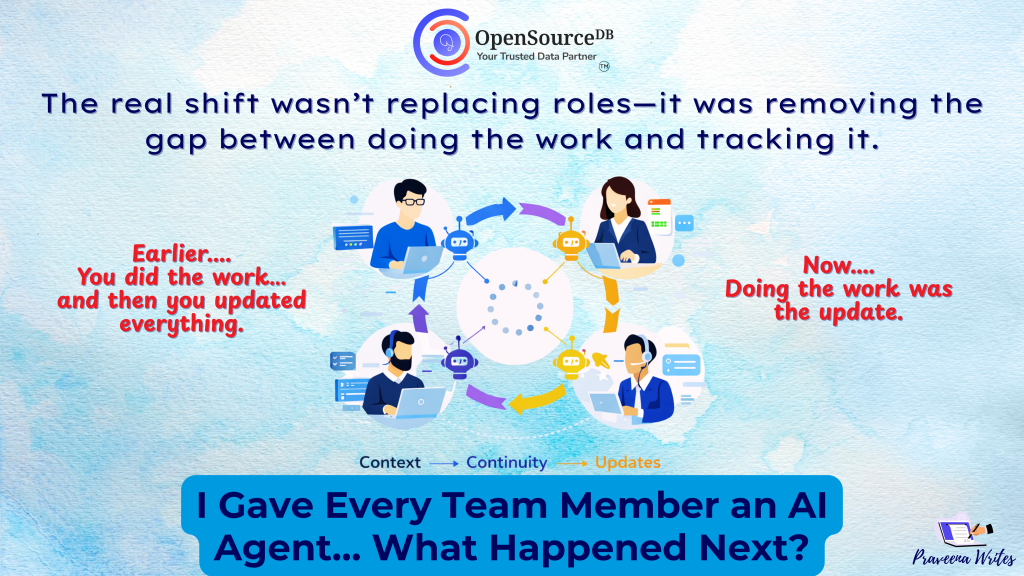
We gave each team member their own AI agent.
Not a shared assistant.
Not another tool to manage.
But something that worked quietly in the background—aligned to their role.
The developer’s agent understood commits, fixes, and progress.
The PM’s agent tracked tasks, dependencies, and movement.
The DevOps agent observed logs, deployments, and incidents.
The SDR’s agent followed conversations and maintained continuity.
At first, nothing felt different.
People continued doing their work.
But the system started doing something new.
Updates began appearing on their own.
Tasks reflected real progress.
Documentation started building itself.
Follow-ups became timely and contextual.
Not because people changed how they worked.
But because the system started understanding how they worked.
Earlier, work and tracking were separate.
You did the work…
and then you updated everything else.
Now, doing the work was the update.
The PM didn’t have to ask, “Any updates?”
The developer didn’t have to remember what to document.
DevOps didn’t just see alerts—they saw context.
The SDR didn’t lose track of conversations.
There were imperfections.
Some summaries needed correction.
Some signals weren’t always right.
But even then, one thing was clear.
The Shift
This wasn’t just automation.
It was continuity.
Context stayed connected.
Work stayed visible.
Nothing important slipped through.
And slowly, something else changed.
People stopped thinking about the system.
Because it no longer demanded attention.
It simply worked alongside them.
So, What Happened Next?
Nothing dramatic.
No big transformation moment.
Just fewer gaps.
Less friction.
More clarity.
Giving every team member an AI agent didn’t replace roles.
It removed the effort around them.
Tracking, documentation, follow-ups—
they became natural outcomes of doing the work.
And once that happened,
the system didn’t need constant updates anymore.
It just… stayed in sync.