
“Any update?”
“Did we capture this?”
“Can someone document this?”
These questions were not exceptions in our workflow. They were the workflow.
We already had systems in place. Odoo was managing projects and tasks. XWiki was meant for documentation. Conversations were happening across meetings, chats, and terminals. Everything existed, yet nothing felt completely in sync.
The problem was not the absence of tools. It was the friction between them.
Work was happening in one place, updates in another, documentation somewhere else. By the time things were manually entered into Odoo or documented in XWiki, context was already lost. Follow-ups depended on memory. Activity tracking depended on discipline. And consistency, as always, was the first thing to break under pressure.
We did not want another tool. We wanted the system to work as one.
That is where our in-house agentic AI came in.
Instead of asking users to update systems, we flipped the approach. The AI started observing the natural flow of work. Command histories, terminal activity, conversations, and task interactions became signals. Instead of being ignored, they became inputs.
If a developer executed commands related to a fix, the AI inferred progress. If a discussion led to a decision, it captured context. If a task moved forward, it reflected that movement without waiting for manual updates.
Odoo was no longer just a task board. It became a real-time mirror of execution.
XWiki was no longer a place where documentation had to be written later. It became a continuously updated knowledge base, generated alongside the work itself.
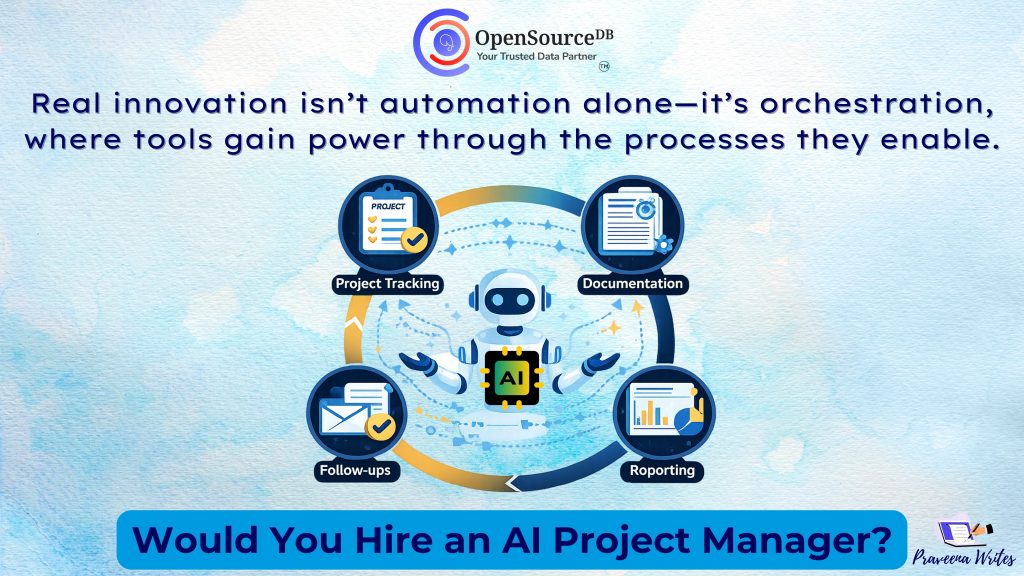
The real innovation was not automation in isolation. It was orchestration.
The AI connected everything. It understood relationships between tasks, activities, discussions, and outputs. It ensured that every action taken by a team member contributed to a structured, traceable, and visible workflow.
Follow-ups became natural outcomes instead of manual effort. If something slowed down, the system knew. If a dependency was at risk, it surfaced it. If a task needed attention, it nudged the right person.
Not as a reminder. As a continuation of the workflow.
Scrum practices also evolved quietly. Standups were no longer about recalling what happened. The system already knew. Instead, they became about decision-making and alignment. Progress, blockers, and summaries
were generated from actual activity, not from memory.
And somewhere along the way, something important changed.
People stopped worrying about “updating the system.”
Because the system was updating itself.
But this only worked because we respected one core principle:
Tools are only as powerful as the process they support.
Odoo gave us structure. XWiki gave us knowledge continuity. But it was the AI layer that ensured both were used consistently, without adding effort to the user.
It did not force behavior. It reduced friction.
It did not replace discipline. It made discipline easier to follow.
Today, project tracking, documentation, follow-ups, and reporting are no longer separate activities. They are outcomes of the same continuous flow of work, orchestrated by AI.
So, would we hire an AI Project Manager?
Not as a person sitting on top of the team.
But as an invisible layer that connects everything the team does.
Because the real breakthrough is not in adding more tools or more processes.
It is in building a system were doing the work automatically keeps everything else updated.
And once that happens, project management stops feeling like overhead.
It just becomes… part of the work itself.