
PostgreSQL is widely used for applications where data availability and durability are critical. As databases grow and recovery requirements become stricter, having a reliable backup strategy is essential. pg_hardstorage is an open-source PostgreSQL backup and recovery solution designed around continuous WAL streaming, base backups, deduplication, and point-in-time recovery (PITR).
Developed by CYBERTEC PostgreSQL International and released under the Apache 2.0 license, pg_hardstorage is designed to provide a transparent and practical approach to PostgreSQL backup management.
What is pg_hardstorage?
pg_hardstorage speaks PostgreSQL’s replication protocol, the same one a streaming replica uses. It runs as a single static binary on a backup host, takes a base backup, and streams WAL continuously. Nothing is installed on the database itself.
Backups are stored in a content-addressed format: data is split into chunks, each named by its hash and stored once. Every backup is self-contained and restores on its own
How it works:
1. Data Plane — PostgreSQL Replication Protocol
- pg_hardstorage uses PostgreSQL’s native replication protocol, similar to a streaming replica.
- It can request both a consistent base backup and WAL stream through a normal libpq connection.
- No shell access or backup agent is required on the PostgreSQL server.
- Only a PostgreSQL role with the REPLICATION attribute and a repository URL are required.
- It can work with bare-metal PostgreSQL, containers, Patroni, and Kubernetes-managed PostgreSQL.
- It cannot perform physical base backups on managed DBaaS platforms that don’t expose the required BASE_BACKUP replication functionality.
2. Store — Content-Addressed Repository
- Backup data is divided into variable-sized chunks using FastCDC.
- Each chunk is identified using its SHA-256 hash.
- Identical chunks are stored only once, providing automatic deduplication.
- Each backup is represented by a manifest containing chunk references and the WAL range.
- Every backup is logically independent—there is no traditional incremental backup chain.
- Deleting an older backup does not break newer backups because unused chunks can be removed safely.
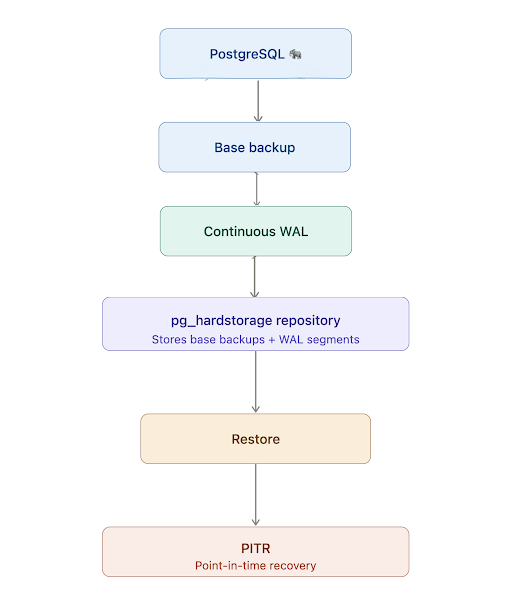
3. Three Main Stages
- Base Backup: Creates a consistent copy of the PostgreSQL cluster and records the starting WAL position.
- WAL Streaming: Continuously streams WAL through a replication slot and stores it in the repository.
- Restore: Reconstructs the database from the selected base backup and replays WAL to the required recovery target.
- PITR can target a specific timestamp, named restore point, or latest available state.
4. One Static Binary
- pg_hardstorage is distributed as a single statically linked binary.
- Nothing needs to be installed on the PostgreSQL database host.
- The binary can run on a dedicated backup server, VM, container, or Kubernetes CronJob.
- The same binary provides backup, WAL streaming, restore, verification, and health-check functionality.
- This makes upgrades easier because the database host remains untouched.
5. Key Design Choices
- No incremental backup chain: Deduplication provides storage efficiency without creating fragile backup dependencies.
- Every backup is independently restorable: Removing an older backup does not automatically invalidate newer backups.
- No proprietary repository: The repository consists of files, chunks, manifests, and metadata.
- The repository can be stored on a filesystem or S3-compatible object storage.
- The repository format is documented and the project is open source under Apache 2.0.
Conclusion
pg_hardstorage is a PostgreSQL backup system that uses the native replication protocol to take base backups and continuously stream WAL into a content-addressed, deduplicated repository, enabling independent backups and precise Point-in-Time Recovery without installing software on the database host.