
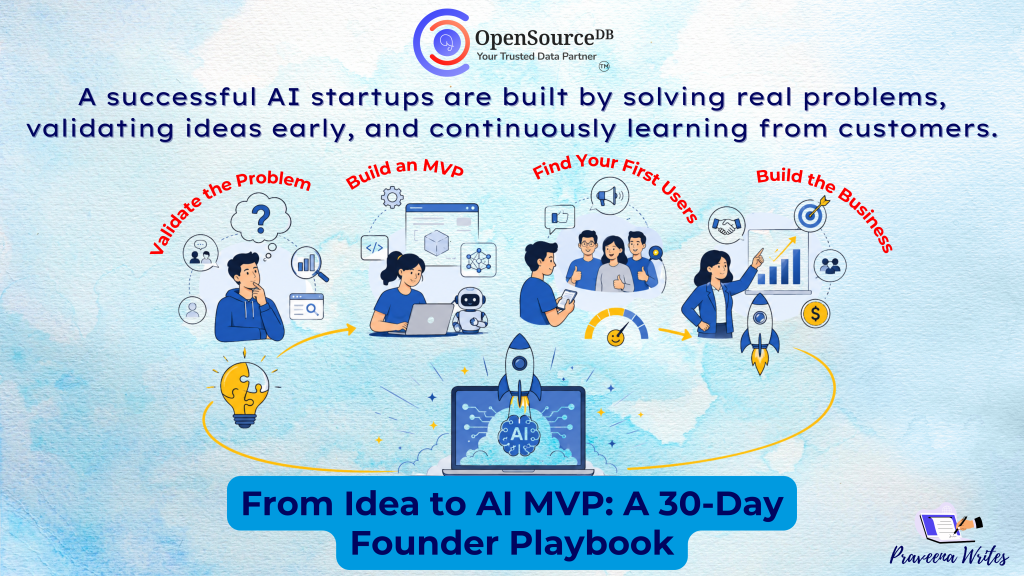
Many aspiring founders assume that building an AI startup requires a large team, massive funding, and months of development. Today, that is no longer true. With the right tools and a clear strategy, small teams can launch AI products faster than ever.
At OpenSource DB, Hari P Kiran often emphasizes that successful AI startups are built by solving real problems, validating ideas early, and continuously learning from customers.
Week 1: Validate the Problem
Before building a product, spend time understanding the problem you want to solve. Many startups fail because they create solutions without confirming whether customers actually need them.
During the first week:
- Speak with potential customers and understand their pain points.
- Identify how they are currently solving the problem.
- Use AI tools for market research and competitor analysis.
- Validate whether users would pay for a better solution.
The goal is simple: ensure that you are solving a real problem before investing time and resources.
Week 2: Build an MVP
Once the problem is validated, focus on building the smallest version of your product that delivers value.
- Build a working prototype quickly.
- Choose the right AI models and supporting tools.
- Focus on one core use case instead of multiple features.
- Avoid overengineering and unnecessary complexity.
Whether it is a chatbot, an AI assistant, a recommendation engine, or an automation platform, your MVP should clearly demonstrate value to users.
Week 3: Find Your First Users
Building the product is only half the journey. The next challenge is getting it into the hands of real users.
Instead of focusing on download numbers, aim to acquire your first 20 users who genuinely care about the problem you are solving.
- Reach out through communities, social media, and personal networks.
- Encourage users to test the product and share feedback.
- Measure engagement, retention, and customer satisfaction.
- Improve the product based on real-world usage.
As Hari often says, early users are not just customers; they are partners in shaping the product.
Week 4: Build the Business
Once your MVP gains traction, shift your focus towards creating a sustainable business model.
- Experiment with different pricing strategies.
- Define your go-to-market plan.
- Identify and engage early adopters.
- Build partnerships and communities around your product.
- Prepare for fundraising if additional capital is needed.
The strongest startups are not always the ones with the best technology. They are the ones that learn quickly, adapt to customer needs, and execute consistently.
Part 2 Checklist
By the end of the first month, you should have:
- Built an MVP.
- Acquired your first users.
- Collected measurable feedback.
- Iterated based on customer insights.
- Established an initial go-to-market motion.
Building an AI startup is no longer about having the biggest team or budget. As Hari P Kiran and the team at OpenSource DB believe, success comes from understanding customers, moving quickly, and solving meaningful problems.
Your first version does not need to be perfect. It simply needs to exist.