
Part 2 of 2: Technical Account Management: Intelligence
Technical Account Management & the 3I Framework
Picking Up the Baton
In Part 1 of this series, we followed OpenSource DB’s Solutions Engineer (SE) through the Input and Insight stages of our 3I Framework, diagnosing a FinTech application, a regional digital wallet and merchant payment gateway, at Stage 1 (Reactive) on our Database Maturity Model, and designing a PostgreSQL architecture built to land it at Stage 3 (Optimized).
When the Technical Account Manager (TAM) takes ownership at handoff, they inherit more than a set of meeting notes. They inherit accountability: the discovery findings, the architectural decisions (PgBouncer pooling, read/write splitting, Debezium/Kafka-based CDC), the customer-facing SLAs, and the explicit target of landing the Customer at Stage 3, Optimized, on the Database Maturity Model.
Where the SE’s job was to design the right destination, the TAM’s job is to prove, continuously and in production, that the destination has actually been reached without the customer ever feeling the ground shift beneath them. That’s the third letter in the 3I Framework: Intelligence, the execution and assurance layer that turns architecture into a lived outcome.
The TAM & the 3I Framework: Operationalizing the Architecture
If the Solutions Engineer is the architect who draws the blueprints, the Technical Account Manager is the master builder who ensures the structure survives production traffic. Where Part 1 covered Input and Insight, Part 2 focuses on the final and most critical pillar of the 3I Framework: Intelligence.
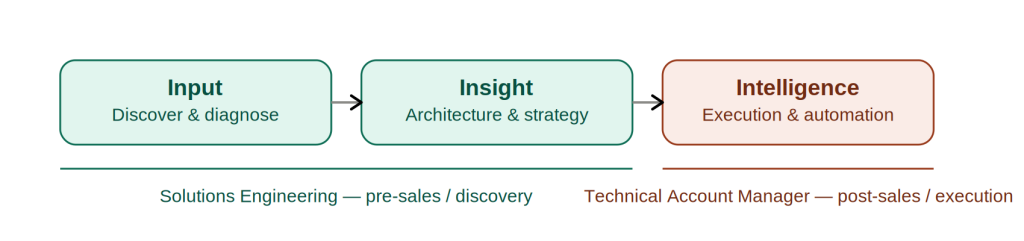
Intelligence is where strategy meets execution. It turns static designs into dynamic, self-correcting migration engines using three core capabilities:
- Automated system verification: continuous, real-time validation without human intervention.
- Cross-functional coordination: aligning engineering, product, and business SLAs.
- Proactive safeguards: cutover gates that trigger automatic rollbacks long before a customer notices degradation.
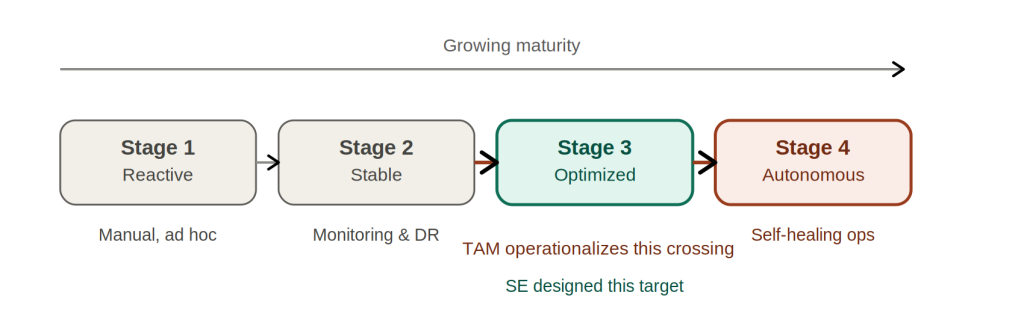
In Part 1, the SE mapped Customer from Stage 1 (Reactive) to a target architecture designed for Stage 3 (Optimized). Now the TAM takes ownership to lead Customer through execution and propel it into Stage 4 (Autonomous).
What a TAM Actually Owns
Where the SE’s job is to translate a prospect’s problems into a credible technical plan, the TAM’s job is to keep that plan honest all the way through execution and beyond go-live. Intelligence means the automated systems, cross-functional coordination, and real-time verification that let a team act on insight before customers ever notice a problem.
The full migration pipeline the TAM coordinates looks like this:
| Discovery & Setup | Migration Execution | Testing & Validation | Production Deployment |
| Schema Auto-MappingAudit Log & Index CleanPgBench Synthetic Load | CDC ReplicationShadow Read ReplaysReconciliation Checks | Delta ReconciliationLoad & Failover Drills | Feature Flag FlipLegacy Decommissioning |
Executing “Intelligence”: The 3-Phase Execution Model
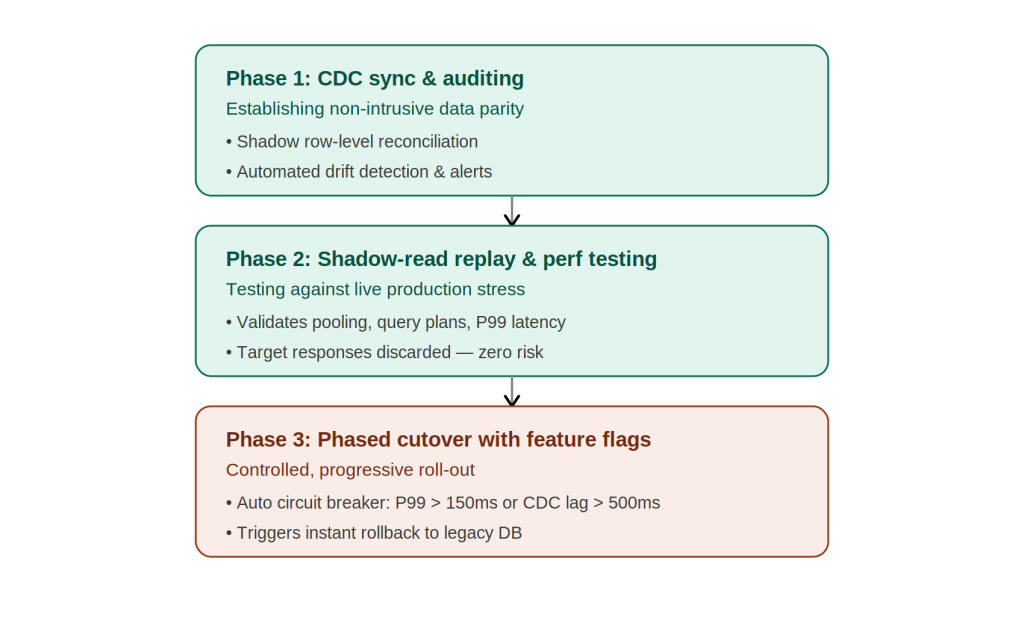
To migrate core ledgers without impacting active transactions, the TAM executes a multi-stage validation framework, each phase gated by hard, automated thresholds rather than judgment calls.
Under the hood, Phase 1 relies on log-based Change Data Capture, Debezium and Kafka streaming updates from the commercial database to PostgreSQL in near-real-time, with background workers comparing hash values of updated ledger rows to catch drift before it reaches production traffic. Phase 2 mirrors real production traffic to the target cluster through an API proxy, validating PgBouncer pooling efficiency, settlement-query execution plans, and P99 latency under actual load, all while target responses are discarded so live payments are never at risk. Phase 3 replaces the high-risk “big bang” cutover with an incremental rollout, protected by automatic circuit breakers that revert traffic the moment latency or replication lag crosses a defined line.
Crossing the Threshold: From Stage 3 to Stage 4
While the SE designed the target architecture for Stage 3 (Optimized), the TAM’s execution layer establishes the automation required for Stage 4 (Autonomous), the point where verification stops depending on a person and starts running itself.
Part 1 argued that a migration isn’t just a technical event, it’s a customer trust event, and that Input and Insight are where an SE keeps CX at the center of technical design. Part 2 closes the loop: Intelligence is where that design gets proven, transaction by transaction, in production, until the customer’s experience of “we migrated our core ledger” is simply that nothing broke.
One framework, two owners, one continuous accountability to the customer from first discovery call to Stage 4.