
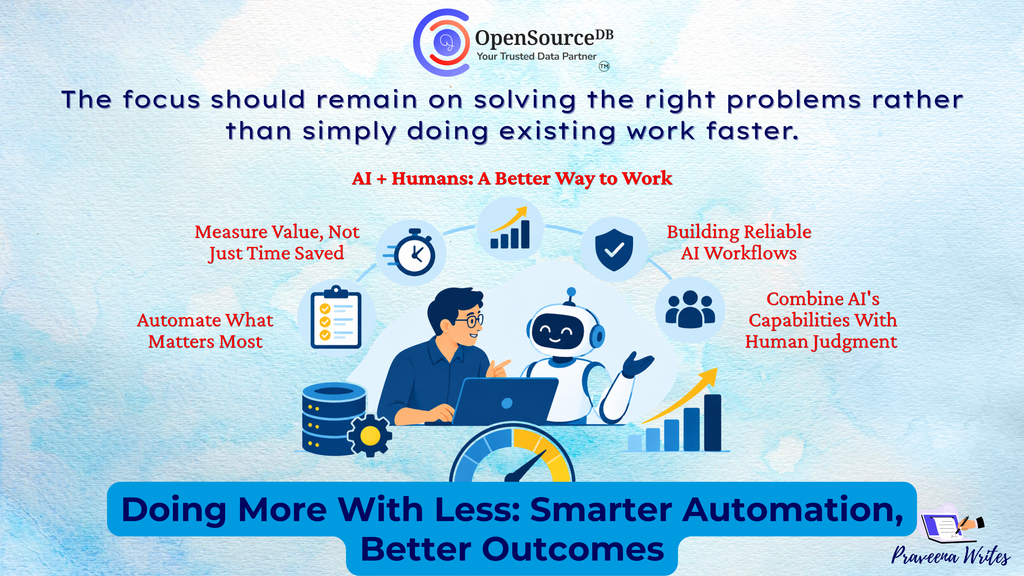
Optimization October – AI Edition Doing More with Less: Smarter Automation, Better Outcomes
Optimization October – AI Edition
Doing More With Less: Smarter Automation, Better Outcomes
AI makes it easier than ever to automate tasks. But the real challenge is not finding more things to automate. It is identifying where automation creates the most value and where human involvement makes the difference.
In Part 1, we explored why not everything that can be automated should be automated. In Part 2, let’s look at how to prioritize automation, measure its value, and build workflows where AI and people work together.
1. Automate What Matters Most
Not every repetitive task deserves an AI solution.
Before automating a workflow, consider three questions:
- How much time and effort does it consume?
- What value will automation create?
- What risks or additional costs could it introduce?
For example, automating a routine report may save hours every week. But using AI to recommend a PostgreSQL performance fix requires a different approach. AI can analyze query plans and suggest improvements, while an engineer evaluates the workload, validates the recommendation, and determines whether it is safe to implement.
The best opportunity is not always the easiest task to automate. It is the one where the benefits outweigh the costs and risks.
Sometimes, simplifying a process delivers more value than automating it.
2. Measure Value, Not Just Time Saved
An AI tool may complete a task in minutes, but speed alone does not guarantee success.
If the output requires extensive corrections, introduces errors, or creates additional maintenance work, the expected savings may disappear.
A meaningful evaluation should be considered:
- Time saved: How much effort is genuinely reduced?
- Quality: Are the results accurate and reliable?
- Total cost: What are the implementation, usage, review, and maintenance costs?
- Business impact: Does the solution improve customer experience, reliability, or decision-making?
For example, generating a report faster is useful. Generating a reliable report that helps a team make better decisions is far more valuable.
AI ROI should reflect the overall improvement, not just the speed of an individual task.
3. AI + Humans: A Better Way to Work
The choice is not always between complete automation and doing everything manually.
Many effective workflows combine the strengths of both.
AI can gather information, summarize documents, identify patterns, draft responses, and suggest solutions. People can validate results, understand context, handle exceptions, and make important decisions.
Consider a PostgreSQL support workflow. AI can help analyze an issue, retrieve relevant documentation, and suggest possible causes. An engineer can then verify the findings and choose the appropriate solution.
Similarly, AI can prepare customer responses, but sensitive conversations still benefit from human understanding and accountability.
The goal is to let AI handle repetitive effort so people can focus on problem-solving, judgment, and meaningful work.
4. Building Reliable AI Workflows
Successful automation requires more than connecting an AI tool to an existing process.
Organizations need to define what AI can do independently, when validation is required, and when an issue must be escalated to a person.
PostgreSQL-based AI applications, including solutions using vector search and retrieval-augmented generation (RAG), can help people access relevant information and work more effectively with data. However, data quality, access controls, accuracy, and operational safeguards remain essential.
At OpenSource DB, the opportunity is to connect PostgreSQL and AI capabilities to real business needs, improving how organizations manage data, solve problems, and make decisions.
Start small, measure the results, learn from failures, and scale only when the solution demonstrates meaningful value.
Conclusion: Optimize the Outcome
AI adoption should not be measured by how many tasks we automate or how many tools we introduce.
It should be measured by whether we reduce unnecessary effort, improve reliability, manage risk, and deliver better outcomes.
At OpenSource DB, as we explore the possibilities at the intersection of PostgreSQL and AI, the focus should remain on solving the right problems rather than simply doing existing work faster.
Part 2 Takeaway
Don’t automate more just for the sake of automation. Prioritize the right opportunities, measure the value created, and combine AI’s capabilities with human judgment to achieve better outcomes.