
This month, we’re bringing back Model March from OpenSource DB — in a sharper, more focused format.
Two blogs → Two critical decisions → Zero hype.
In this first part, we address one of the most common — and most misunderstood — AI architecture questions:
How should you implement LLMs in your business?
Because once a company decides to “add AI,” the real confusion begins.
Do you:
- Call an API from providers like OpenAI or Grok?
- Build a RAG-based system?
- Fine-tune an open-source model from Meta or Mistral AI?
- Or attempt a hybrid approach?
Let’s break this down clearly.
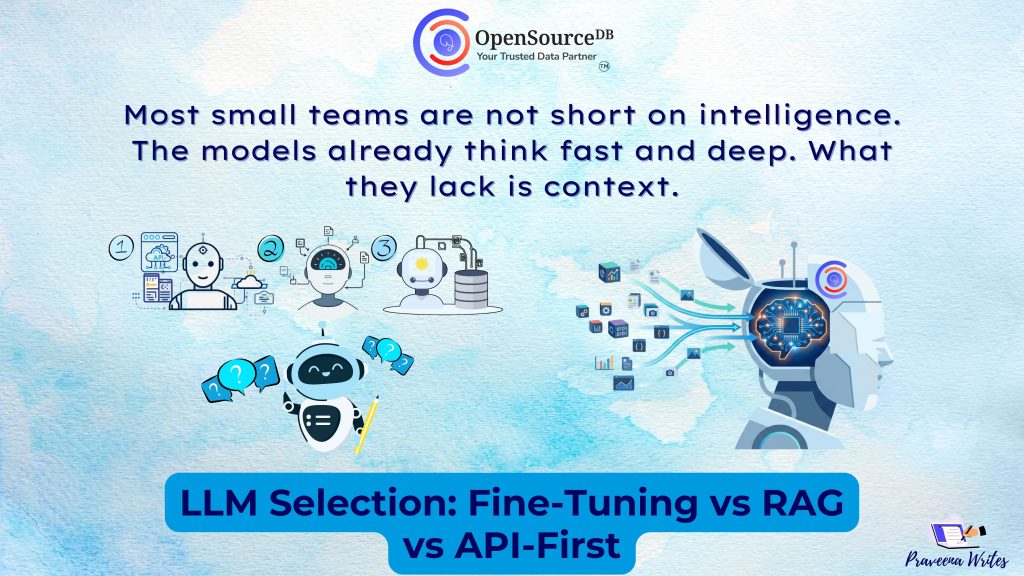
Most small teams aren’t short on intelligence. The models already think fast and deep. What they lack is context — your documents, your processes, your latest customer notes — the information no public model has ever seen.
So the real choice usually boils down to three paths.
First path: Call an API
Use APIs from providers like OpenAI, Grok, or other frontier model providers.
No servers.
No GPUs.
No DevOps nightmares.
You simply plug it in, ship the feature in weeks, and focus on what actually matters — whether users like it and are willing to pay for it.
Yes, there are trade-offs:
data privacy considerations, API costs, and dependency on external providers.
But for speed, early validation, and lean teams, nothing beats it.
Most small to medium businesses start here.
Second path: Fine-tune an open model
Here you take an open model and train it with your own data until it behaves exactly the way you want.
It starts speaking in your brand voice.
It follows your preferred output structure.
It even understands your strange internal terminology.
When it works, it can feel magical.
But the moment you choose this road, you also sign up for:
- High-quality training datasets
- GPU budgets
- Model training pipelines
- Periodic retraining every time your product or documentation evolves
It’s heavy.
And importantly, it still doesn’t solve the context problem.
If your latest spec sheet isn’t part of the training data, the model is still guessing.
For most companies starting their first AI project, this path is too early, too expensive, and too distracting.
Third path: RAG (Retrieval-Augmented Generation)
RAG avoids retraining entirely.
No weight updates.
No model retraining cycles.
Instead, it creates a bridge between the LLM and your knowledge base.
Your documents are stored in a vector database.
When a user asks a question, the system retrieves the most relevant content and inserts it into the prompt.
Suddenly the model can answer using your real, up-to-date information.
Update a Google Doc?
The knowledge base refreshes.
No six-week retraining cycle.
Costs stay reasonable.
The model remains general-purpose and intelligent.
And it becomes extremely good at solving practical problems like:
- Customer support assistants
- Internal copilots
- Document search and Q&A
- Knowledge assistants for teams
Get the retrieval right — clean documents, good chunking, proper embeddings — and RAG quietly solves nearly 80% of what most SaaS companies actually need.
The pattern most teams discover
Across the industry, a clear pattern has emerged:
Start with an API to prove people care.
Add RAG when you realize context is the bottleneck.
Fine-tune later — if ever — when you need the final layer of tone or behavior that retrieval alone cannot provide.
How we approach this at OpenSource DB
At OpenSource DB, we have built a tight chain of actions that continuously feeds our RAG pipeline with fresh data.
Our internal processes connect tools like:
- Odoo task handlers
- XWiki knowledge repository
- A set of home-grown automation tools
This pipeline ensures that our knowledge base keeps evolving automatically — allowing our AI systems to stay context-aware, current, and useful without constant retraining.
In Part 2, we will explore the next big question for business leaders. Stay tuned!