
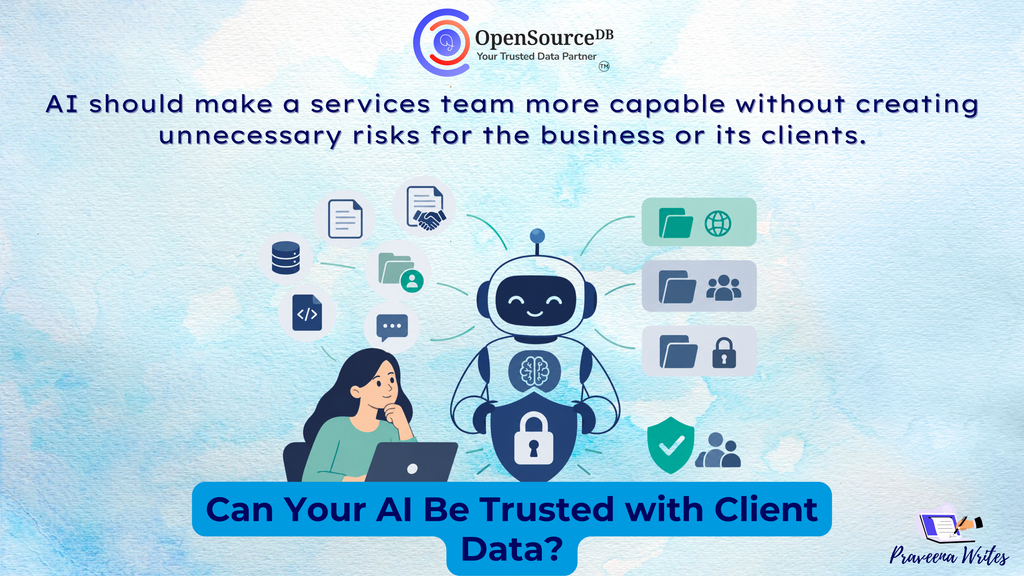
Optimization October – AI Edition Doing More with Less: What Should We Not Automate?
AI has made automation easier than ever.
We can generate code, analyze data, summarize documents, create reports, respond to customers, and automate repetitive workflows with just a few prompts and integrations.
But as the cost of automation decreases, a more important question emerges:
Just because we can automate something, does it mean we should?
At OpenSource DB, this question matters as we work at the intersection of PostgreSQL, enterprise technology, Data, and AI.
The goal is not to automate everything. It is to use automation where it creates meaningful, measurable value—and to recognize where human judgment remains essential.
At OpenSource DB, we believe technology services need to move beyond measuring effort and focus more on outcomes. AI makes this shift even more important. Saving time is useful, but the real question is whether that time saved translates into better decisions, improved reliability, lower costs, or greater business value.
Automation Is Not the Same as Optimization
It is tempting to automate every repetitive task.
- A report takes 30 minutes? Automate it.
- An email takes 10 minutes? Automate it.
- A meeting takes an hour? Summarize it with AI.
- A developer spends time troubleshooting? Let an AI agent help.
But saving time does not automatically mean creating value.
Sometimes, a five-minute human decision can prevent hours of unnecessary work.
Sometimes, reviewing a customer requirement manually is more valuable than automatically generating a response.
And sometimes, keeping a human in the loop is not inefficiency. It is good engineering and good business.
Consider a PostgreSQL performance issue. An AI system might identify a slow query and recommend adding an index. The recommendation may be technically valid, but before applying it, we need to understand the workload, write patterns, storage constraints, and potential operational impact.
Creating an index is an action. Improving overall performance without introducing new problems is the outcome.
That is the difference between automation and optimization.
The goal is not maximum automation. It is maximum useful output with minimum unnecessary effort.
What Should We Not Automate?
1. Decisions That Require Context
AI can analyze information quickly, but context often exists beyond the available data.
A customer may have a technical requirement, but understanding why they need it may require a conversation. The stated requirement may be only one part of a larger business problem.
Similarly, a PostgreSQL performance issue may appear to be a database problem when the underlying cause is an application design decision, an infrastructure constraint, or a business requirement.
AI can identify patterns, gather evidence, and suggest possible causes. People still need to validate assumptions, understand the broader context, and determine the right course of action.
Automation can identify patterns. Human judgment helps turn those patterns into meaningful decisions.
2. High-Impact Decisions Without Appropriate Safeguards
Some decisions should never become a case of “set it and forget it.”
Production changes, security decisions, database migrations, financial approvals, and customer commitments can have consequences far greater than the time saved through automation.
- AI can recommend.
- AI can analyze.
- AI can prepare.
But high-impact actions need safeguards proportionate to their potential consequences. Depending on the risk, these might include testing, explicit approval, monitoring, rollback mechanisms, or escalation to an accountable person.
Not every automated action needs manual approval. Routine, well-tested operations can often run automatically within clearly defined boundaries.
The important distinction is between automating execution and surrendering control.
Automation can perform the task. Accountability for the outcome must remain clear.
3. Processes That Are Broken
One of the biggest mistakes organizations make is automating a bad process.
If a process requires five unnecessary approvals, adding AI does not solve the underlying problem. It simply makes the inefficient process faster.
Before automating a process, ask:
- Can we eliminate unnecessary steps?
- Can we simplify the workflow?
- Can we standardize what remains?
- Do we understand the actual problem we are trying to solve?
Sometimes, the best optimization is deleting a step rather than automating it.
A useful sequence is simple: understand the process, remove unnecessary complexity, improve what remains, and then automate where it makes sense.
Do not automate waste. Eliminate it first.
4. Human Relationships
Not every conversation should become an automated message.
Customer relationships, mentoring, leadership conversations, feedback, conflict resolution, and important team discussions depend on trust, empathy, and understanding.
AI can help prepare for a conversation, organize thoughts, summarize follow-up actions, or provide useful background information.
But it should not become a substitute for listening, understanding, and taking responsibility.
This is especially important for organizations like OpenSource DB, where technology and community are closely connected. Knowledge sharing, mentorship, and collaboration are not simply workflows to optimize.
They are part of the value we create.
The opportunity is to use AI to make human interactions more effective—not to make them less human.
The Human-in-the-Loop Principle
A useful way to think about AI automation is:
- Automate the repetitive.
- Assist the complex.
- Review the important.
- Own the outcome.
This principle is not about requiring a person to approve every automated action. It is about designing systems with the right balance of autonomy, oversight, and accountability.
- A repetitive, low-risk task may be suitable for full automation.
- A complex problem may benefit from AI-assisted analysis and human judgment.
- A high-impact decision may require additional validation, approval, or safeguards.
Instead of asking:
“Can AI do this task?”
Ask:
“What is the highest-value role AI can play in this process?”
Sometimes the answer is full automation. Sometimes it is decision support. Sometimes it is simply helping a person get started faster.
The right choice depends on the value created, the risks involved, and the consequences of getting it wrong.
OpenSource DB Perspective
PostgreSQL provides a powerful, open, and extensible foundation for solving real-world data problems. As AI becomes part of modern data architectures, the same foundation opens up new possibilities.
Capabilities such as PostgreSQL-native AI architectures, vector search, retrieval-augmented generation (RAG), and AI-assisted database operations can help organizations build intelligent applications, retrieve relevant knowledge, and improve how they work with data.
But adopting these technologies is not an end in itself.
The real questions are:
- Does this help people find the information they need more effectively?
- Does it improve database reliability or operational efficiency?
- Does it reduce unnecessary effort without introducing disproportionate risk?
- Does it help the business make better decisions?
At OpenSource DB, the opportunity lies in connecting PostgreSQL and AI capabilities to measurable business outcomes; not simply adding AI to existing workflows.
That is the real meaning of optimization.
Technology should help us solve the right problems, make better decisions, and focus our effort where it creates the most value.
AI should not make us busier.
It should help us focus our time on the work that matters.
And sometimes, the smartest AI decision is knowing what not to automate.
Part 1 Takeaway
Don’t automate a task just because you can. Automate it when the value created outweighs the cost, risk, and complexity introduced.