
In the previous Journey June AI Edition article, we explored a question that many founders quietly ask themselves: Will AI replace founders?
The more I reflected on that question, and the more conversations I had with Hari Kiran, Founder of OpenSource DB, the more I realized that perhaps we were focused on the wrong concern.
The real transformation is not happening because AI is replacing leaders. It is happening because AI is forcing leaders to rethink one of the most fundamental aspects of leadership itself: delegation.
For years, founders have struggled with delegation for the same reason. Deep down, many believe that no one will do the work as well as they can. It is not always arrogance. Often, it comes from care, responsibility, and a genuine desire to maintain quality. But regardless of the intention, the result is often the same. Leaders become deeply involved in everything.
What is fascinating is that AI triggers exactly the same reaction.
The first time you trust a machine with meaningful work, whether it is research, planning, communication, analysis, or content creation, the immediate challenge is not technical. The challenge is psychological. The instinctive response is often, “This is good, but I could probably do it better myself.”
That reaction is what makes this such an interesting leadership story.
The more we explored AI, the more it became clear that the technology was not exposing the limitations of machines. It was exposing the habits that leaders have carried for years.
AI Exposed the Real Challenge Behind Delegation
One of the most interesting insights Hari shared during our discussions was that delegation is rarely a capability problem. Most people assume delegation fails because the person, or in this case the machine, cannot perform the task effectively.
In reality, the problem is often much simpler.
The expectations were never clear.
When leaders work directly on a task, much of the context exists in their heads. They know the objective, understand the nuances, recognize the constraints, and instinctively know what a successful outcome looks like. When they delegate, they often assume that understanding has been transferred.
In most cases, it has not.
AI makes this painfully obvious.
When a machine produces a poor result, the first instinct is often to blame the tool. However, after spending time working with AI, a different pattern emerges. The quality of the output is heavily influenced by the quality of the instructions. Vague goals produce vague outcomes. Missing context creates incomplete responses. Undefined expectations lead to inconsistent results.
To get useful output from AI, leaders are forced to articulate things they may never have explicitly stated before. They must define the goal, explain the context, communicate the constraints, and describe what “good” looks like.
This is not an AI skill. It is a leadership skill.
The same clarity that helps a machine produce better results is the clarity that helps people succeed.
The Discomfort of Letting Go
What makes this lesson particularly interesting is that it mirrors one of the oldest challenges in leadership.
Most founders do not struggle to delegate because they lack capable people. They struggle because they have spent years building, solving, fixing, and making decisions. Their identity often becomes closely tied to being the person who gets things done.
As a result, delegation can feel uncomfortable.
There is always a voice in the background saying, “No one will do this as well as I will.”
The surprising part is that AI triggers exactly the same instinct.
The discomfort has very little to do with technology. It comes from letting go of control.
In many ways, AI acts as a mirror. It reveals habits that have always existed but were easier to overlook when working only with people. It forces leaders to examine whether they are truly delegating or simply holding on to control under the guise of maintaining quality.
From Doing to Creating Clarity
Perhaps the most significant insight from these conversations was that AI is changing where leaders create value.
For a long time, leadership was often associated with execution. Leaders were expected to solve problems, answer questions, work harder than everyone else, and stay involved in every important decision.
That approach may have worked when execution itself was the primary challenge.
Today, the challenge is different.
As machines become capable of handling more execution work, leadership becomes less about doing and more about enabling.
The shift is subtle but important.
Leaders move from doing to enabling.
They move from controlling to creating clarity.
They move from having all the answers to asking the right questions.
They move from being the hardest worker in the room to setting direction.
This does not make leadership less important. If anything, it makes leadership more important because clarity becomes a competitive advantage.
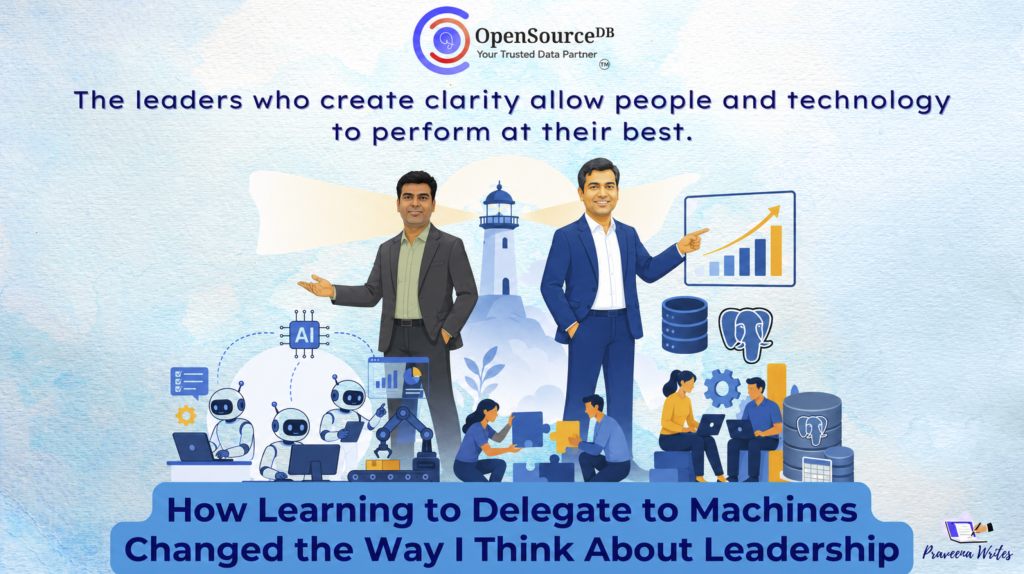
The leaders who create clarity allow people and technology to perform at their best.
The Unexpected Lesson About Trust
One of the most surprising outcomes of working with AI is that the lesson is not really about trusting machines.
It is about trusting people.
Once leaders understand that delegation succeeds through clarity rather than control, their perspective begins to change.
Instead of asking whether someone else can do the work as well as they can, they begin asking whether they have provided enough context and direction for success.
That is a very different mindset.
Delegation stops feeling like a loss of control.
It starts feeling like an act of leadership.
The goal is no longer to personally own every task. The goal is to create an environment where great work can happen without constant intervention.
Whether the work is performed by a team member or supported by AI, the principle remains the same.
Trust grows when clarity exists.
Final Thoughts
The more I reflect on Hari’s insights, the more I believe that the most valuable AI conversations are not really about technology.
They are about leadership.
AI is exposing something that has always been true. The leaders who create the greatest impact are rarely the ones who do everything themselves. They are the ones who create clarity, build trust, and enable others to succeed.
Perhaps that is why the most important question in the age of AI is no longer:
“How much can I do myself?”
Instead, it becomes:
“What becomes possible when I trust the right work to the right hands, human and machine alike?”
That shift does not simply change how we work.
It changes how we lead.