
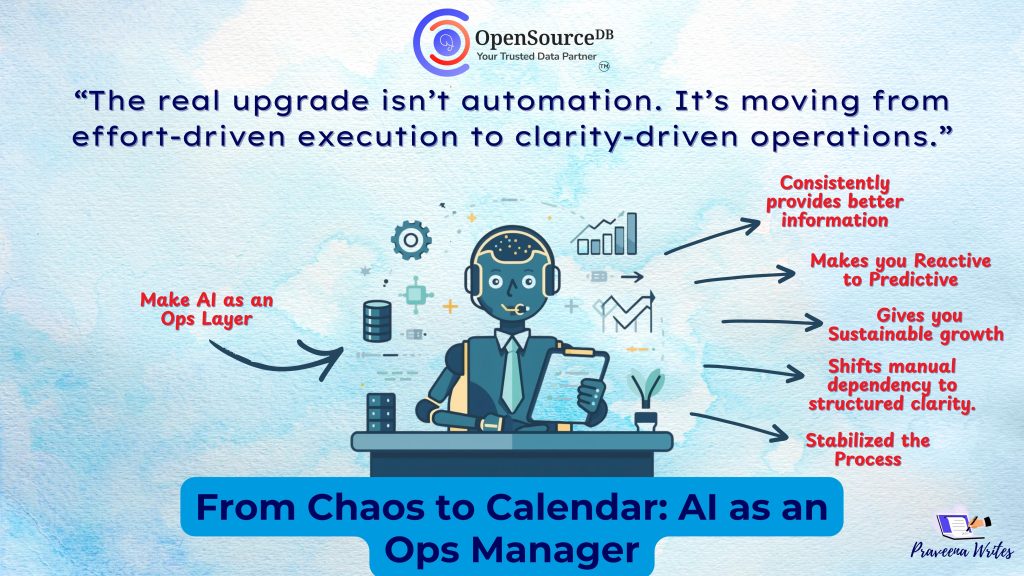
From Chaos to Calendar: AI as an Ops Manager
Most services startups don’t suffer from lack of effort.
They suffer from fragmented attention.
At OSDB, work was always happening. Clients were being served. Projects were moving. Deadlines were being met. From the outside, everything looked productive.
But internally, operations were scattered.
Information lived across Slack threads, Odoo updates, XWiki documentation, spreadsheets, and memory. Work was getting done — but planning was reactive. Priorities shifted based on urgency. Calendars filled themselves. Context had to be manually stitched together.
Nothing was technically broken.
But nothing was structured either.
And that’s the kind of system that works — until it doesn’t.
The Problem with Founder-Led Ops
In the early stages of a services company, operations are often human-powered.
Updates are manually connected. Decisions are made quickly. Firefighting becomes normal. Planning happens after something goes wrong, not before.
It works because people compensate. Teams try harder. Leaders remember more. Someone always steps in to fill the gap.
But this model quietly depends on effort over structure.
And effort does not scale.
When operations live inside conversations and memory, growth starts increasing friction instead of momentum.
When AI Became an Ops Layer
Initially, AI was just another productivity tool.
It helped draft faster. Summarize quicker. Respond better.
But the shift happened when AI stopped being used as a tool and started functioning as an operational layer.
Instead of asking AI to create content, it was asked to create clarity.
It began consolidating signals from Odoo and XWiki. It surfaced priorities instead of flooding dashboards with raw data. It highlighted risks before they turned into emergencies. It suggested planning windows rather than just listing deadlines.
The change wasn’t dramatic.
But it was stabilizing.
From Reactive to Predictive
The real transformation wasn’t speed. It was predictability.
With intelligent tracking in place, overload became visible before burnout. Dependencies were flagged early instead of being discovered mid-project. Documentation gaps surfaced automatically. Follow-ups stopped depending on someone remembering.
The tone of operations changed.
Instead of asking, “What broke today?”
The question became, “What needs attention next week?”
That subtle shift moved the company from reactive execution to predictive planning.
And that changes everything.
What Actually Changed
AI didn’t suddenly make everyone faster.
It made everything calmer.
Status meetings were reduced because visibility improved. Weekly planning felt clearer because priorities surfaced early. Ownership became more transparent. Decision fatigue at the top reduced because information arrived structured, not scattered.
AI didn’t accelerate chaos.
It stabilized it.
And stability compounds over time.
What We Learned
One thing became very clear through this process: bad processes automated become faster bad processes. Technology cannot fix broken thinking.
Ops automation is cultural before it is technical. It requires teams to trust systems instead of memory.
And trust doesn’t come instantly. It builds when visibility improves consistently.
The hardest part wasn’t implementing AI.
It was shifting from manual dependency to structured clarity.
The Quiet Manager
AI will not replace your operations team.
But it can become the quiet manager that never forgets, never gets tired, and consistently provides better information for humans to make decisions.
The real upgrade isn’t automation.
It’s moving from chaos to calendar.
From effort-driven execution to clarity-driven operations.
That’s the shift that makes growth sustainable.