
One question has become increasingly common among startup founders:
“How do we add AI to our product?”
It’s a valid question, but at OpenSource DB, while working with startups across different stages of growth, we’ve realized it’s not the best place to begin.
Instead, founders should ask:
“If AI already exists, how would we build our startup differently from Day One?”
This simple shift in thinking separates startups that merely use AI from those that are built for the future.
An AI-first mindset doesn’t mean building an AI product. It means designing your business, workflows, and customer experience with AI as a core principle from the very beginning.
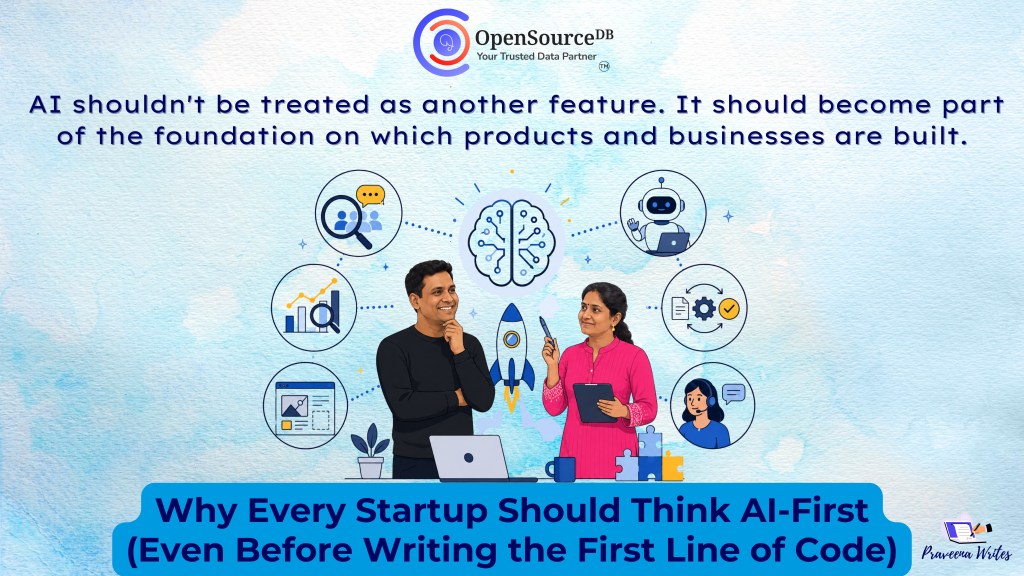
As Hari Kiran often says, AI shouldn’t be treated as another feature. It should become part of the foundation on which products and businesses are built.
AI-First vs. AI-Enabled
Many startups today are AI-enabled. They build a product first and later integrate AI capabilities such as chatbots, recommendations, or automated summaries.
An AI-first startup approaches things differently. Before building, founders ask:
- Which repetitive tasks can AI automate?
- Which decisions can AI assist with?
- How can AI improve customer experience from Day One?
- Where should people focus while AI handles routine work?
This approach creates products that scale better, teams that operate more efficiently, and businesses that innovate faster.
Start with the Problem, Not the Technology
One of the biggest mistakes founders make is becoming excited about AI before identifying the business problem they want to solve.
Every organization has repetitive workflows:
- HR teams screen resumes.
- Sales teams qualify leads.
- Finance teams process invoices.
- Customer support teams answer recurring questions.
- Operations teams prepare routine reports.
These repetitive tasks are ideal opportunities for AI.
The objective isn’t to replace people. It’s to eliminate repetitive work so teams can focus on creativity, strategic decisions, and delivering greater value to customers.
AI Can Help Before You Build
One of the biggest advantages founders have today is that AI is valuable long before product development begins.
Before writing a single line of code, AI can help with:
Customer Discovery
- Generate interview questions.
- Summarize customer conversations.
- Identify recurring pain points.
Market Research
- Analyze competitors.
- Discover market trends.
- Identify gaps and opportunities.
MVP Validation
- Draft landing pages.
- Create product messaging.
- Generate wireframes and validate ideas before investing heavily in development.
At OpenSource DB, we encourage founders to use AI to accelerate research and decision-making while continuing to validate every assumption with real customers.
The 10x Founder Mindset
Being a 10x Founder isn’t about working longer hours.
It’s about working smarter with AI.
Today’s founders can use AI to brainstorm ideas, write documentation, prepare presentations, review code, summarize meetings, create marketing content, and automate routine tasks.
Think of AI not as just another chatbot, but as a co-founder for execution. While it won’t replace vision, leadership, or decision-making, it can help founders move faster, validate ideas sooner, and accomplish significantly more with smaller teams.
The founder provides the vision.
AI accelerates the execution.
Common Mistakes to Avoid
As AI adoption grows, founders should avoid a few common pitfalls:
- Building AI because it’s trending instead of solving a real customer problem.
- Skipping customer validation and assuming AI alone creates value.
- Overengineering too early before achieving product-market fit.
- Chasing every new AI model instead of focusing on customer outcomes.
- Ignoring user experience, where technology becomes more complicated than helpful.
Successful startups don’t build AI because it’s fashionable.
They build AI because it solves meaningful business problems.
Final Thoughts
AI is no longer a competitive advantage reserved for large enterprises. Open-source models, cloud platforms, and modern AI frameworks have made it accessible to startups of every size.
At OpenSource DB, we’re seeing founders move faster and build smarter when they think AI-first from the very beginning rather than treating AI as an afterthought.
As Hari Kiran often emphasizes:
“Don’t ask where AI fits into your startup. Ask how your startup would look if AI had been part of the founding team from Day One.”
That one question can influence every product decision, every workflow, and ultimately, the long-term success of a startup.
Founder’s AI-First Checklist
Before building your startup, ask yourself:
- Have I clearly defined a real customer problem?
- Have I identified repetitive workflows that AI can automate?
- Have I validated the need with at least five potential customers?
- Have I decided whether to build custom AI capabilities or integrate existing AI solutions?
- Am I solving a genuine business challenge instead of simply following the latest AI trend?
What are your thoughts?
If you were building a startup today, would you adopt an AI-first approach from Day One, or would you introduce AI after building your product?
I’d love to hear your perspective in the comments.