
Artificial Intelligence has become one of the fastest-growing investments for startups and businesses. But while everyone is excited about building AI products, very few teams are asking an important question:
Can your AI infrastructure scale without draining your budget?
Many founders believe that adding more GPUs automatically means better AI performance. Others assume that buying expensive hardware is the first step toward building an AI company.
The reality is very different.
A successful AI platform is built on smart architecture, efficient databases, optimized inference, and careful infrastructure planning—not just bigger GPUs.
At OpenSource DB, we’ve worked with organizations building data-intensive systems, PostgreSQL deployments, and scalable architectures. One lesson remains consistent across projects:
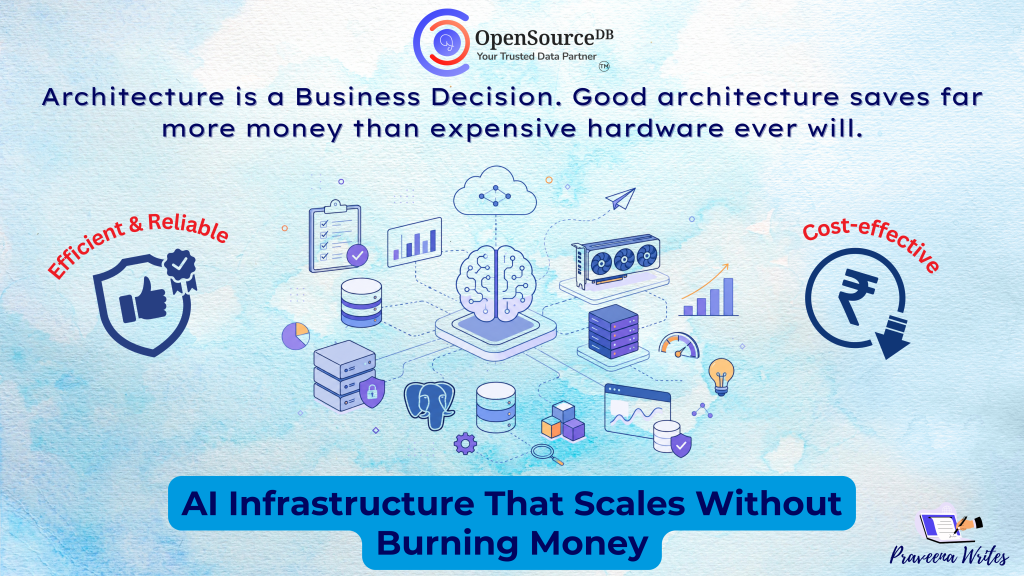
Good architecture saves far more money than expensive hardware ever will.
AI Infrastructure Isn’t Just About GPUs
When people hear “AI Infrastructure,” they immediately think about GPU clusters.
In reality, AI applications involve several equally important components:
- Data storage
- Feature pipelines
- Vector databases
- Model serving
- API gateways
- Caching
- Monitoring
- Cost optimization
A poorly designed architecture creates bottlenecks long before GPU utilization reaches 100%.
The Biggest Cost Mistakes Startups Make1. Overbuying GPUs
Many startups purchase expensive GPUs before validating product-market fit.
Instead:
- Start with cloud GPUs
- Measure actual inference demand
- Scale only when utilization justifies it
Pay for usage—not assumptions.
2. Ignoring Database Design
AI models are only as good as the data they retrieve.
Poor indexing, slow queries, and duplicated storage often become larger performance bottlenecks than model inference itself.
This is why database architecture deserves the same attention as model architecture.
3. Treating Every Request Equally
Not every AI request requires your largest model.
For example:
- FAQ responses
- Search
- Classification
- Summaries
- Recommendations
can often run on smaller, faster, and significantly cheaper models.
Routing requests intelligently reduces inference costs dramatically.
Choosing the Right Vector Database
Retrieval-Augmented Generation (RAG) has become the foundation for modern AI applications.
This raises one common question:
Should I use PostgreSQL with pgvector or a dedicated vector database?
There isn’t a universal answer.
PostgreSQL + pgvector works well when:
- You’re already using PostgreSQL
- Structured and vector data live together
- Operational simplicity matters
- Team expertise is centered around Postgres
- Dataset size is manageable
Dedicated Vector Databases shine when:
- Handling billions of embeddings
- Ultra-low latency search
- Highly specialized retrieval workloads
- Massive AI search platforms
For many startups, PostgreSQL with pgvector provides an excellent balance between simplicity, flexibility, and performance.
Latency vs Cost
Everyone wants low latency.
But lower latency often comes at a price.
Reducing latency usually requires:
- Larger GPU instances
- More replicas
- Higher memory
- Better networking
- Increased idle capacity
The key is understanding what your users actually expect.
If your application delivers valuable responses in two seconds instead of one, many users won’t notice—but your cloud bill certainly will.
Architecture is about balancing experience with economics.
FinOps for AI Inference
Inference has become the largest recurring cost for many AI products.
Instead of focusing only on model accuracy, teams should also monitor:
- Cost per request
- Cost per customer
- GPU utilization
- Cache hit rates
- Token consumption
- Model routing efficiency
Small improvements across these metrics can reduce monthly infrastructure costs significantly.
Practical Optimization Tips
Consider implementing:
- Prompt caching
- Semantic caching
- Batch inference
- Autoscaling
- Smaller models for routine tasks
- Efficient embedding pipelines
- Query optimization in PostgreSQL
- Monitoring dashboards for infrastructure costs
These improvements often deliver better ROI than purchasing additional hardware.
Architecture is a Business Decision
Technology choices directly affect business outcomes.
Good architecture enables:
- Faster feature delivery
- Lower infrastructure costs
- Better customer experience
- Sustainable scaling
- Predictable operational expenses
Every architecture decision is also a financial decision.
Building Smarter with OpenSource DB
At OpenSource DB, we believe scalable AI starts with strong data foundations.
Our expertise in PostgreSQL, performance tuning, distributed systems, and modern data architectures helps organizations build AI platforms that are efficient, reliable, and cost-effective.
As AI adoption accelerates, the winners won’t simply have the biggest GPU clusters—they’ll have the smartest architectures.
Invest in your architecture today, and your infrastructure will continue delivering value as your business grows.
Architecture August with OpenSource DB
Throughout this month, we’ll explore practical AI infrastructure topics, PostgreSQL innovations, database performance, distributed systems, and cost-efficient AI engineering to help founders and engineering teams build scalable products with confidence.